My Talk “Narrativity and VR” Will Be Featured at ELO Conference

My talk/paper “Narrativity in Virtual Reality: From Meaning-Making to World-Building” has been accepted and will be featured at the Electronic Literature Organization Conference in Vancouver in June. Work on the trailer for QueerskinsVR should be done by April, so I will be able to show it then as part of the talk. 

Using my own experience in translating a work of electronic literature into virtual reality as a point of departure, I will look at how storytelling in VR differs from and is similar to storytelling in other formats. Drawing examples from cinema, video art, video games, electronic literature and early VR experiments, I will examine trends in narrativity which predate the emergence of VR as a significant storytelling medium. These include: the move away from what Hiroki Azuma calls “grand” and “small” narratives to “database” narrative and the accompanying changes in perceptions and evocations of time and space, the move away from characters to processes that create affective asymmetries that I will relate to Thomas LaMarre’s analysis of Japanese anime, the move from meaning-making to aesthetics including the tendency to emphasize musicality (rhythm, repetition, and tone) over verbal semantics that relates to Flusser’s theory of gesture and Kojéve’s meditations on the end of history, the move from “authenticity” to kitsch and performativity that I will discuss via the writings of Walter Benjamin, Brecht, and Celeste Olalquiga, and lastly, the increasing role of “things” as a form of narrative that I will examine in light of Ian Bogost’s writings on video games and object-oriented ontology. 

I will end with a discussion of desire, intentionality, presence, and subjectivity in storytelling using the example of my new work in progress Queerskins VR,  which combines 360 degree video and computer modeled environments to tell the story of a devoutly Catholic mother’s relationship to the estranged son she has lost to AIDS.
“The Failure of Narrative: Cinema and Storytelling at the End of the World”

zabriskie 2

My proposal for a talk at “Forms of the Apocalypse” a symposium at Université Paris 8 in March has been accepted.

In this paper, I draw upon examples from film and video to examine how the idea of apocalypse plays out in storytelling, not simply in terms of content: the trope of mass destruction, but in terms of narrativity, the processes by which a story is presented and interpreted. In keeping with the etymology of “apocalypse” as an uncovering or revealing, I define apocalypse not as the end of the world, but rather the end of the world as we have known it, that is to say, epistemologically.

What humans know of the world largely depends upon the technologies we use to “see” it. This, in turn, influences how we communicate this knowledge. The move away from written language to visual language, which cinema initiated, continues. As we transition from language- based storytelling to experiential storytelling most notably with the creation of virtual realities, the very notion of what we know and how we know it comes into question.

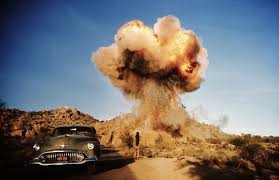
Using examples taken from feature films including Antonioni’s visionary Zabriskie Point as well as examples from video art : Mark Amerika’s Immobilité and Keren Cytter’s “French Film” and “The Hottest Day of the Year,” I will point out trends in narrativity which correspond to changes in technology. These include: the move away from what Hiroki Azuma calls “grand” and “small” narratives to “database” narrative and the accompanying changes in perceptions and evocations of time and space, the move away from characters to processes that create affective asymmetries that I will relate to Thomas LaMarre’s analysis of Japanese anime, the move from meaning-making to aesthetics including the tendency to emphasize musicality (rhythm, repetition, and tone) over verbal semantics that relates to Flusser’s theory of gesture and Kojéve’s meditations on the end of history, and the move from authenticity to kitsch and performativity and its relationship to virtuality that I will discuss via the writings of Walter Benjamin, Brecht, and Celeste Olalquiga. I will end with a discussion of desire, intentionality, presence, and subjectivity in storytelling using the example of my new work in progress Queerskins VR.

I Will Be Curating a Performance and Interactive Sessions Featuring Work from the Third Electronic Literature Collection at The Kitchen

It’s official I’ll be curating a 5 hour performance/interactive workshop at renowned experimental art/performance space The Kitchen in NYC on Saturday, September 10th, 2016 featuring work from the Electronic Literature Collection vol. 3.  This should be especially interesting for writers, visual artists, interactive designers and game designers. More information soon.

New Series on VR as an Emerging Art Form on Huffington Post

I’ve started a new series about VR as an emerging art form on The Huffington Post. First up is a review of Marie-Laure Ryans Narrative as Virtual Reality 2 which looks at VR through the lens of writing and reading. I promise lots of interesting stuff–art, storytelling, science, philosophy, ethics, the nature of reality–next up Rachel Rossin, Virtual Reality Fellow at The New Museum’s incubator lab. As always, please share and Tweet. It’s tough competing with photos of naked celebrities. 0

Queerskins selected for inclusion in The Electronic Literature Collection Vol. 3

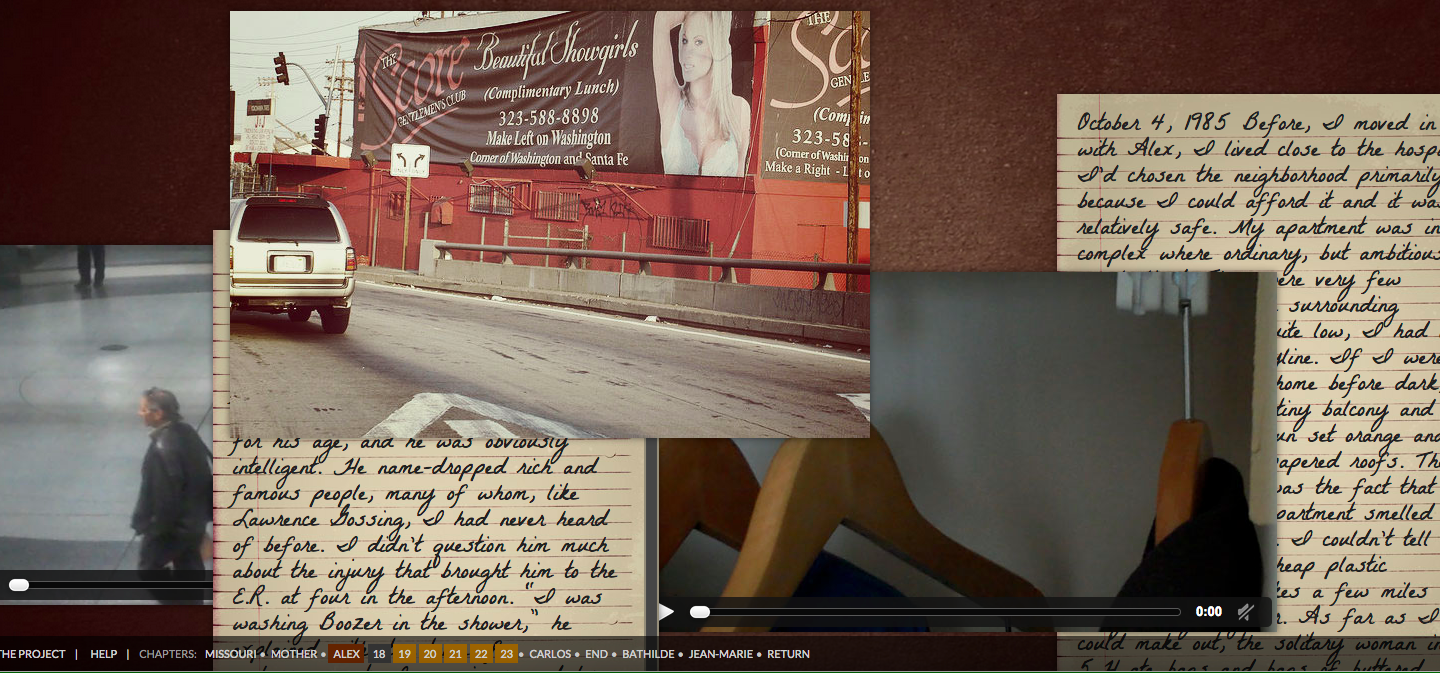
#tech #elit #queer Really pleased to be included in the next Electronic Literature Collection. If you haven’t had a chance to check  out Queerskins, try it in Chrome or Safari. Thanks as always to my collaborator Cyril Tsiboulski, interactive designer and co-founder of Cloudred Studio. Queerskins explores the nature of love and forgiveness through the story of a young gay physician from a rural Missouri Catholic family who dies of AIDS at the beginning of the epidemic. It consists of 40,000 words of diaristic text, two hours of audio monologues from five different characters, and over a hundred photos and videos curated from Flickr Commons and YouTube and beautiful little Fiip videos of L.A. by filmmaker Jarrah Gurrie.

queerskins screenshot 2

#MobileMayakovsky will be realized at CCI Fabrika artspace in Moscow Summer 2016

#MobileMayakovsky is a mobile lounge/library/workshop/performance space designed by architect Peter Franck. It is a public art project that brings the linguistic playfulness, exaggerated style and oblique political commentary inherent to
the manifesto into the digital age. Inspired by the life and poetry of Vladimir Mayakovsky,  the project provides participants the opportunity to learn about, reflect upon, and be inspired by early Russian avant-garde artists, both their revolutionary artistic achievements and the often violent repression of their artistic freedom.  With the help of local artists, graphic designers, and poets, passersby will create their own manifestos, which will be printed on site,Tweeted, and performed. In the process, we hope that Russians will reclaim the avant-garde as a celebrated part of their history and creatively respond to current political, social and cultural conditions which stymie free artistic expression. Mayakovsky is a problematic figure in Russia who has been used/resurrected for many purposes. We are, in a sense, resurrecting him again, as a problematic symbol of rebellious creativity that was stifled for political purposes (Mayakovsky himself writing that he “stepped on the voice of his own song”.) The library offers visitors, especially younger people, the opportunity consider the Russian avant-garde  in all its complexities, and, then,  inspired and/or disturbed by this knowledge, to create their own manifestos that will be printed, tweeted and exhibited on site.

I realize the current atmosphere in Russia  may make this project problematic, but I do think of this as a celebration of that early age of creativity in Russia, which, whether Putin likes it or not, was truly revolutionary. Is there any promise of revolution, let alone utopia left in the world? Is there any thought that art might play a role in this? Probably not. For me,  Obama was the great hope for change which never came. My personal belief  post-Obama is that  change  will come incrementally with strangers working together temporarily to accomplish small tasks. And, yes, I still harbor the naive hope that art plays a critical role in this.

Atomic Vacation Makes First Cut for Creative Capital

Atomic Vacation combines a contemporary database-influenced narrative with

the emotional potency of oral history to generate spaces for actively

contemplating national identity, global citizenship, technology and

embodiment. While players explore Google landscapes of the American West,

visiting places of natural beauty like the Grand Canyon, as well as sites

of nuclear missile storage and testing, Shizuku, a robot girl from the

possible future, narrates the Pinnochio-esque story of her former life on

Earth. Along the journey, the player encounters archival objects (image,

video, sound and text)  from Cold War history (e.g. remarkably callous

State Department films about HIroshima, Paul Robeson’s  testimony

about being considered “less than an American” before the House

Un-American Activities Committee, etc.) and the present-day (e.g. DARPA

research on “narrative neurobiology,” a rescued egg-farm

chicken’s first walk on grass, the Japanese news report about a

prototype robot girl). Players can access other players’

contributions of data (text, sound, and image) offered in response to

in-game challenges, and contribute their own.  Part multimedia fiction,

part historical archive, part community art project (players earn points

for tweets and for adding media to the game) AV allows players to interact

with their present-day selves from the vantage point of a post-apocalyptic

future. The object of the game is to prevent that future from becoming a

reality and to engage players in small, but personally meaningful acts of

archiving, contemplation, and aspiration. The final project will be an

Android app with narrative extensions housed and distributed through

Twitter.